Piazzolla in Brooklyn (2011)
Buy:

Listen:




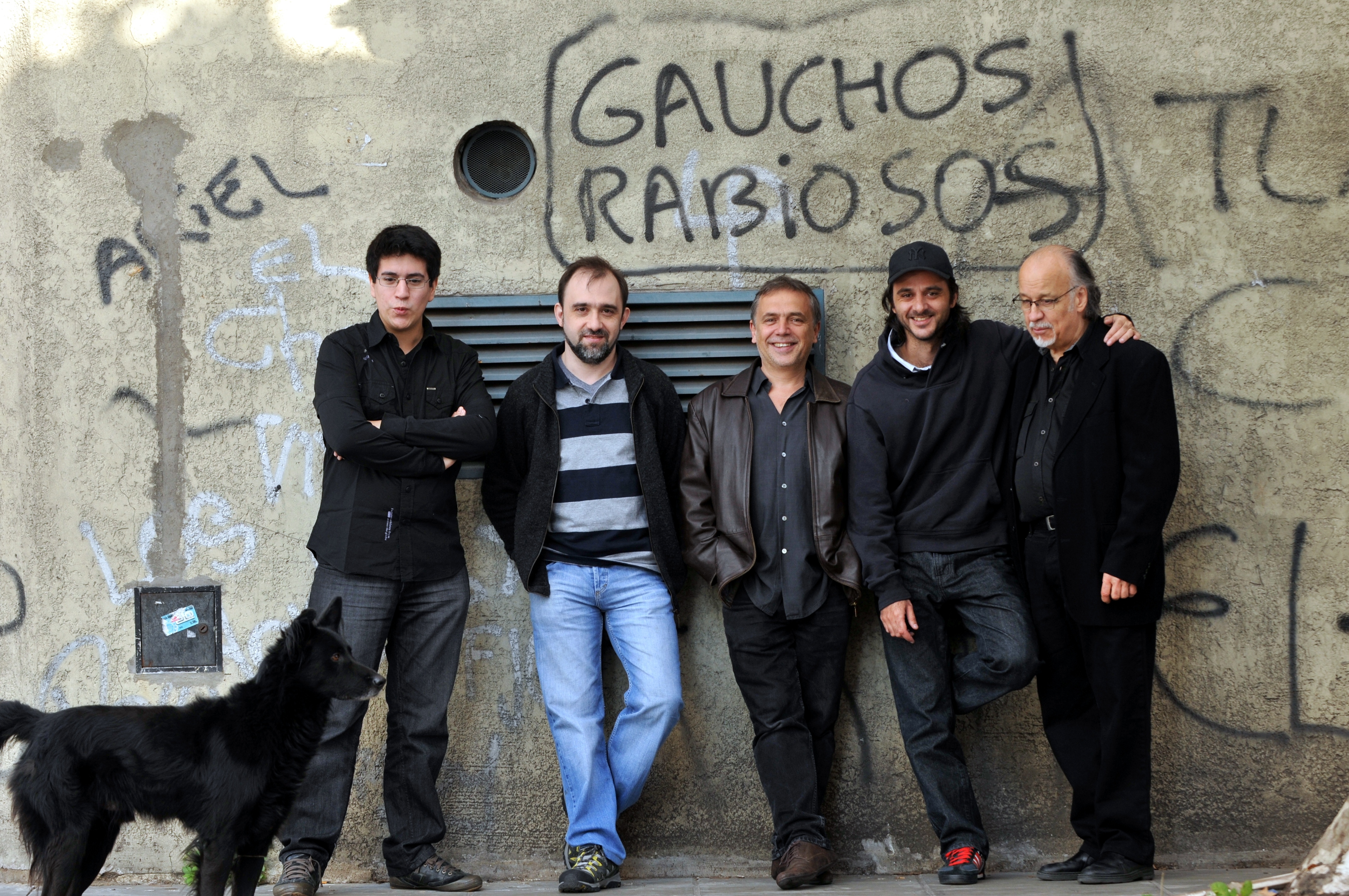
Gustavo Bergalli, trumpet
Nicolas Enrich, bandoneon
Abel Rogantini, piano
Pablo Aslan: bass
Daniel “Pipi” Piazzolla, drums
Arrangements by Astor Piazzolla
Transcribed by Pablo Aslan, Nicolas Enrich, and Abel Rogantini
Re-arranged by Pablo Aslan
Produced by Pablo Aslan
Associate Producer: Fernando Gonzalez
- La Calle 92 (Astor Piazzolla)
- Counterpoint (Astor Piazzolla)
- Dedita (Astor Piazzolla)
- Laura (David Raskin)
- Lullaby Of Birdland (George Shearing)
- Oscar Peterson (Astor Piazzolla)
- Plus Ultra (Astor Piazzolla)
- Show Off (Astor Piazzolla)
- Something Strange (Astor Piazzolla)
- Triunfal (Astor Piazzolla)
“Piazzolla originals are played with new élan“ – LatinJazz.net
“There may be odder ambitions than wanting to remake what Astor Piazzolla considered the worst album of his career, but give bassist Pablo Aslan credit: at least he did the job right.
If this is the musical equivalent of speculative fiction, let’s hope Aslan brings us more.”
J.D. Considine DOWNBEAT **** (4 Star)
GRAMMY NOMINATED NOTES BY FERNANDO GONZALEZ (Best Album Notes 2011)
Not only masterpieces spark new work. Piazzolla in Brooklyn, the new recording by Argentine-born, Brooklyn-based bassist, bandleader, and producer Pablo Aslan, was inspired by a dreadful album. Take Me Dancing, a 1959 jazz tango recording by New Tango master Astor Piazzolla, was dreadful. Piazzolla said so.
Recorded in Buenos Aires with a group of musically bilingual Argentine players, including Daniel “Pipi” Piazzolla, the maestro´s grandson, on drums, Piazzolla in Brooklyn updates Takes Me Dancing into state-of-the-art jazz tango.
“I was attracted by the idea of recreating this damned Piazzolla album, through the optic of jazz tango, something that I had spent many years developing for myself,” he says. “I felt there were many places where the music could be opened up and developed further. I began to imagine which aspects of the pieces could use a more extended formal treatment, which ideas just went by too fast and could stand further elaboration, and where the solo sections could occur. That was the Eureka moment, when I realized that the material in this record had a potential that just needed to be unleashed.”
Aslan has been working on jazz tango for the past 20 years. He grew up in Buenos Aires in the 1960’s and 70’s, but moved to the United States to study music. After graduating from the University of California Santa Cruz, and attending Cal Arts, and UCLA, he headed to New York City in 1990. By then he had ediscovered tango and had become “the tango guy.” He played traditional gigs, for dancers.
For years he was a regular feature in milongas (tango dance halls) around the United States and in concert performances with Raul Jaurena, Pablo Ziegler, and Yo Yo Ma’s Soul of the Tango. But he also started to probe the possibilities of jazz tango.
Early on he formed a trio with the late saxophonist Thomas Chapin and pianist Ethan Iverson (The Bad Plus), “without really knowing what I was doing. I just formed this band,” he says. “ I put some charts together where everybody could solo and improvise. Interesting stuff would happen, but I couldn’t necessarily say that it was real tango, which is what I was trying to do.”
But the hard work paid off in recordings such as Avantango (2004), Buenos Aires Tango Standards (2007) and, most notably, Tango Grill (2009) an album that earned GRAMMY and Latin GRAMMY nominations.
As he began planning the follow up to Tango Grill, Piazzolla’s Take Me Dancing was just a curiosity. “I had heard all the infamous stories about this recording, so when I saw Take Me Dancing in a record shop in Buenos Aires, I snatched a copy,” he recalls. “And it played exactly as I expected: it was awful. It was just as Piazzolla had presented it.” There was very little jazz and a simplified, clunky Piazzolla played to a guiro-and-bongo beat.
How much of this was due to artistic ideas, commercial considerations or some mix of both is open to discussion. In 1959, Piazzolla was back in New York, where he had spent most of his childhood, looking for a
fresh new start for a sputtering career. Take Me Dancing was his most ambitious gambit. It was a recording of originals and standards interpreted, by an ad-hoc Jazz Tango Quintet, comprising electric, guitar, vibes, piano and bass, plus small percussion. (One of the percussionists was Dominican bandleader, musician, and producer Johnny Pacheco, who would go on to develop salsa and co-found the influential Fania Records.)
Piazzolla had high hopes for the record — but it sank without a trace.
Artistic experiment or commercial ploy, at the time Piazzolla thought of Take Me Dancing as “marvelous.” For the rest of his life, he denounced it as “an artistic sin” and worse. But when Aslan read a critical reevaluation of Piazzolla’s career (Diego Fischerman and Abel Gilbert’s study Piazzolla El Mal Entendido, Piazzolla The Misunderstood) and the comments about Take Me Dancing he was intrigued into giving it a second listening. “And I really liked what I heard,” sounding still surprised. “In a way, it sounded to me like it was undiscovered Piazzolla. The rhythmic approach obscured the writing. The themes and ideas were actually very strong and original, but the percussion made it sound monotonous. And while this was called a jazz tango album, frankly there is virtually no improvisation in it, and what improvisation there is, it occurs in some isolated moments, generally against a written out background, and very briefly.”
What Aslan also heard in Take Me Dancing was a challenge and an opportunity. He went back to Buenos Aires and called on Gustavo Bergalli, trumpet, Nicolas Enrich, bandoneón, Abel Rogantini, piano, and “Pipi” Piazzolla, drums, players as knowledgeable and comfortable with the vocabulary, syntax, and rhythms of tango as they are with jazz.
“I needed these players for a recording like this,” explains Aslan. “Piazzolla in Brooklyn is about taking chances, dynamics, interaction, spontaneity, even some messiness,” he says. “It’s a personal view, and it’s spontaneous, created by the musicians in the moment.”
The transcriptions by Aslan, Enrich, and Rogantini of the original arrangements by Piazzolla for nine of the pieces in Take Me Dancing became the road map for Piazzolla in Brooklyn. “La Calle 92,” which opens the record like a scene setter, is the only track here that is not from Take Me Dancing. It’s a piece by Piazzolla titled after the New York City street where he and his family lived during this period.
Two of the tracks are jazz standards, “Laura,” and George Shearing’s classic “Lullaby of Birdland.” The rest of the pieces are a mix of original compositions that would never become part of Piazzolla’s repertoire, older songs in a new guise and also hints at the Piazzolla to come. “Counterpoint,” with its fugal structure, later developed fully in pieces such as “Fuga y Misterio;” “Dedita,” a piece written for his then-wife Odette ‘Dedé’ Wolff; “Show Off,” a new spin of “Para Lucirse,” a tango he had already arranged for tango master Anibal Troilo’s orchestra. And then there’s “Triunfal,” the piece that, in Piazzolla’s lore, he showed to fabled teacher Nadia Boulanger who then, impressed, encouraged him to continue writing tangos. Ironically, Aslan points out, the piece here becomes “almost hard bop.”
“I did not set out to re-harmonize or change his writing at all, or to add any of my ideas,” he explains. “That was a self-imposed limitation — but also I did not need to. The objective was to reformulate the arrangements so that the individual contributions of each musician were allowed to flourish.”
For Aslan, Piazzolla in Brooklyn was a chance to finally address Piazzolla in his own terms. “He was a model and an inspiration for my work,” he says. “But I also systematically avoided his music. I always felt that it was too strong and defined, and that his own interpretations very rarely have been surpassed. In Piazzolla In Brooklyn I found my own way into Piazzolla’s music, a place where I could create my own world and actually interact with him.”
LISTEN TO REVIEW ON NPR
DOWNBEAT **** (4 Star)
There may be odder ambitions than wanting to remake what Astor Piazzolla considered the worst album of his career, but give bassist Pablo Aslan credit: at least he did the job right. The story begins in 1959, when the Argentine tango giant was working as a session musician in New York. Working with a half-dozen or so jazz and Latin session players, he arranged an assortment of jazz standards and original tunes in a style that tried to apply a bebop twist to a tango-based pulse. But the rhythm work was mechanical and there wasn’t another solo voice for Piazzolla to play off of, making the end result – released on Tico Records as Take Me Dancing! – utterly undeserving of it exclamation point.
Aslan, an Argentine bassist and composer with a strong background in both jazz and Tango Nuevo, recognized both the potential and failings of Take Me Dancing! And does an excellent job of rescuing Piazzolla’s original combination of bandoneon, piano, guitar and percussion but allowing room for improvisation by all the players, not merely the leader.
As such, Piazzolla in Brooklyn easily lives up to the composer’s early imagining of jazz tango. Nicolas Enrich’s bandoneon is nearly as supple and inventive as the master’s, and deftly evokes the mannered melancholy of the film ballad “Laura”, while Gustavo Bergalli’s lithe, authoritative trumpet lines bring a bop-pish brashness to the Piazzolla-ized “Lullaby of Birdland”.
But drummer Daniel “Pipi” Piazzolla – Piazzolla’s grandson – is the most important link here, for as his playing moves easily between a loping jazz drove and a taut tango pulse, he bridges the gap between jazz and tango in ways the original album never imagined.
If this is the musical equivalent of speculative fiction, let’s hope Aslan brings us more. – J.D. Considine
JAZZ TIMES
In 1959, according to the liner notes to Piazzolla in Brooklyn, the 38-year old Argentinean tango master Astor Piazzolla, then based in New York, assembled a band and recorded an album called Take Me Dancing! whose intent was to bridge jazz with his own favored genre. By all accounts, even his own, Piazzolla failed miserable, artistically and commercially, and he never revisited the idea.
Bassist Pablo Aslan, also originally from Buenos Aires and long a New York resident, has built a career of fusing the two worlds that his inspiration couldn’t. On this latest release, he is determined to finish the job his mentor started: Piazzolla in Brooklyn (which title, aside, was recorded in Buenos Aires) resurrects and updates the music of the long-out-of-print original, and this time it’s no flop.
For the project, Aslan, rather than call on established jazz players, uses his own Argentinean quintet, bandoneon player Nicolar Enrich, trumpeter Gustavo Bergalli, pianist Abel Rogantini and drummer Daniel “”Pipi” Piazzolla (grandson of the legend). All but two of its 10 tracks (animated back-to-back runs through George Shearing’s “Lullaby of Birdland” and Johnny Mercer’s “Laura”) were written by Piazzolla, among which is one simply called “Oscar Peterson”. Reducing the core group to trio – bandoneon and trumpet sit it out – Aslan pays tribute, via Piazzolla, to another master, not so much by co-opting the iconic pianist’s style as molding it to expound upon his concept.
Bergalli and Enrich more than make up for that brief hiatus throughout the rest. They lock in tightly on tracks like “Something Strange” and the appropriately titled “Counterpoint” and, with Aslan’s crisp and distinct bass lines, the young Piazzolla’s razor-sharp timing and Rogantini’s vibrant melodies , allow Astor Piazzolla’s misfire to come to fruition more than a half-century later.
– Jeff Tamarkin
“This record is a triumph not only because Pablo Aslan pulls off a miracle, but also because he sets a fifty-year-old grudge right; something that can only please the resident spirit of the great Astor Piazzolla who started it all in the first place.” Raul da Gama (READ THE ARTICLE)
MORE REVIEWS:
lucidculture
jazzhistoryonline
allaboutjazz.com